
The argument
Why this matters
Screens decide what people believe about each other. The communities most affected by that have the least hand in it.
Everyone is watching something
More of what people think they know about each other now arrives through a screen than through a conversation.
A person can go a whole week without speaking to anyone from a different faith, and still form a firm opinion about them — from a drama, a news package, a documentary, a clip that came past on a phone.
That is not a complaint about the industry. It is a description of how opinion is formed now. And it means the people making what appears on those screens are doing something more consequential than entertainment.
And the depiction travels further than the correction
The evidence on this points one way and it is uncomfortable. A harmful portrayal moves an audience further than a sympathetic one does. Damage travels faster than repair, and it does not wait for a right of reply.
So the useful response is not another film explaining a community to an audience. It is changing who is holding the camera — who is in the room when the decisions are made, who sits in the edit, and who gets to say *that is not what it looks like from the inside.*
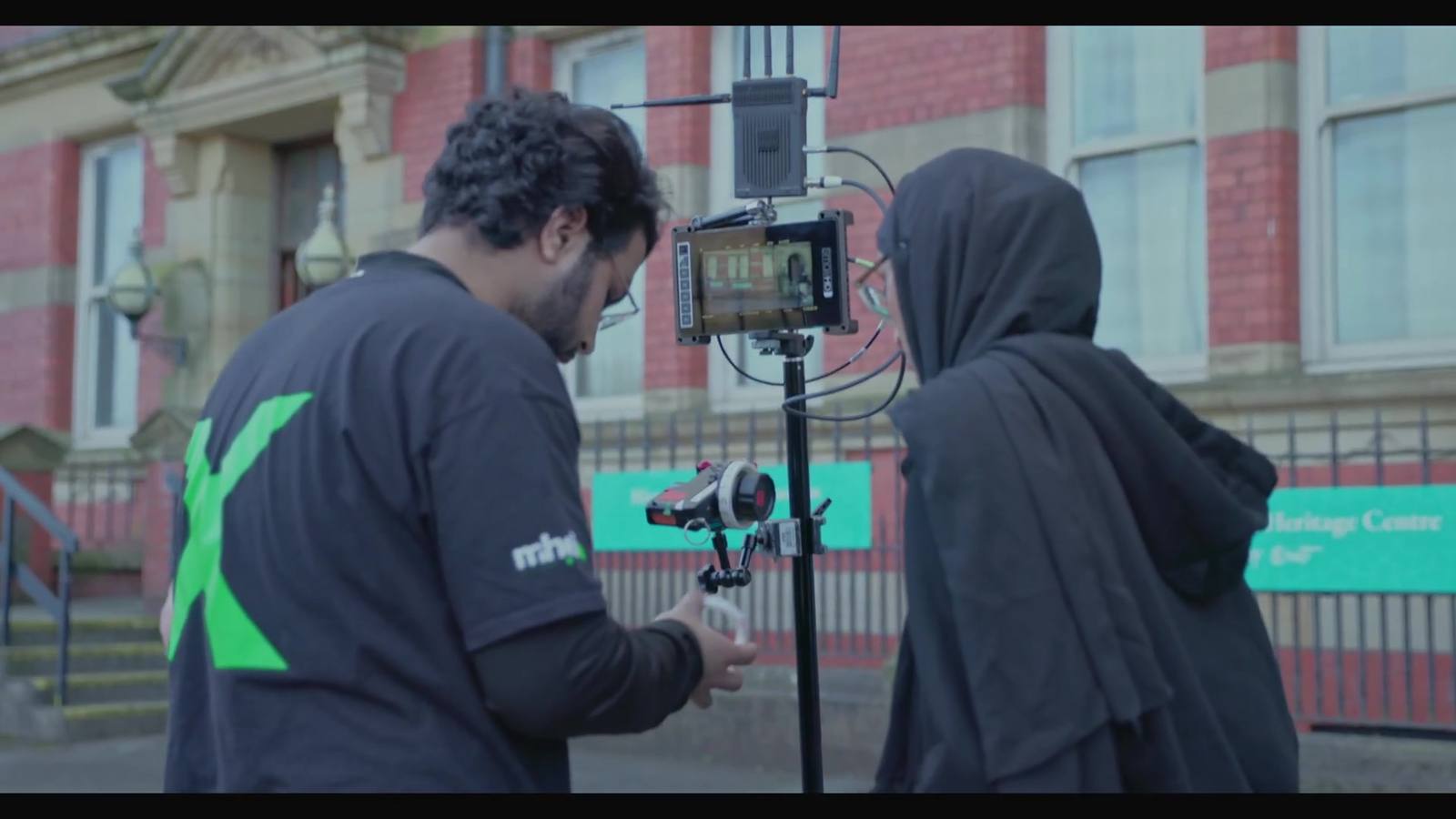
Thirty seconds, no voiceover. A monitor village, a woman in a hijab calling a shot, the crew responding. The argument made without a word of it spoken.
Pinewood Futures Festival 4K B-roll.
Meanwhile the country thinks it is coming apart
People say Britain is more divided than they have ever known it, and at the same time report that their own street gets along perfectly well. Both things are true at once, which tells you where the work is.
A large number of people rarely meet anyone from a different background at all — and as often as not the reason is not hostility. There is nowhere to go and no money to get there.
That is a practical problem, and it has a practical answer: a room, a reason to be in it, and the fare to get there.
What a film unit does that a meeting cannot
Everyone holds a role
Nobody outranks anybody by virtue of who they are. The camera does not care what you believe.
Everyone needs each other
The day does not happen unless the sound recordist and the focus puller and the runner all do their part.
There is something at the end
A finished thing that belongs to all of them, which is a different bond from having agreed about something.
Nobody has to discuss their faith
They have to get the day in the can. The relationship is a by-product of the work, and that is why it holds.
So this is one organisation doing one thing
It looks like several. It is not.
Training a woman to the standard of high-end drama, putting an untold story through the Lab, running a screening and the hour of argument afterwards, teaching a group to shoot on the thing in their pocket, bringing three congregations onto the same unit — these are the same intervention at different scales.
Each one moves a person closer to the point where what appears on a screen about her community was made with her in it.
What we claim, and what we do not
We can tell you why this works as an instrument, and the reasoning is sound.
We cannot yet tell you it worked, because the research in this field has barely looked at adults and almost never at creative work. So we measure it from the first cohort and we publish what we find, whether or not it flatters us.